Back From a Fabulous Vacation:
And Reality is hitting hard today.

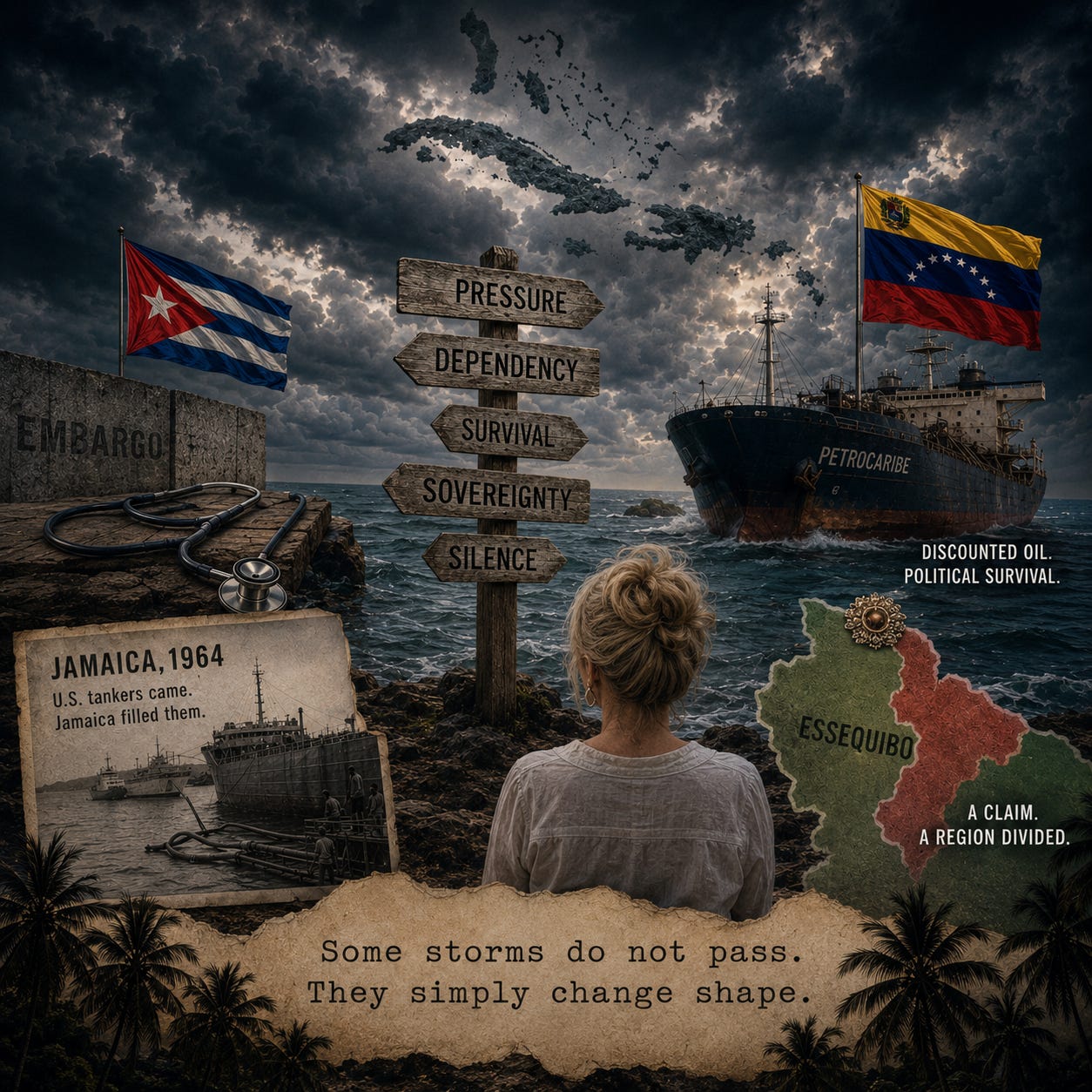
My books are very political. I’ve always admitted that, but I’ve made a conscious choice to keep my personal commentary quiet and let the stories speak for themselves. Today, I’m breaking that rule, because what is unfolding in the Caribbean right now is too significant to stay silent about.
Things are heating up. And I’m genuinely not sure how I feel about it, or what, if anything, can be done to stop what feels like a brewing storm.
The question being asked across the region right now: Has CARICOM’s time finally come?
Let’s start with Cuba.
The U.S. is escalating. Trump has called Cuba a “failing nation,” floated the idea of a “friendly takeover,” and suggested he might “stop by Cuba” after the war in Iran. Secretary of State Rubio, the son of Cuban immigrants who fled before the revolution, is calling for “new people in charge.” In response, Cubans are signing a mass petition called “My Signature for the Homeland,” a sovereignty declaration that some mock and others call an act of defiance.
And CARICOM? Largely silent.
Former Jamaican Prime Minister PJ Patterson publicly called out current PM Andrew Holness for failing to stand with Cuba when the U.S. demanded that Cuban doctors leave Jamaica. But Holness wasn’t alone. Across the region, leaders calculated their own interests and looked away. The blockade on Cuba, which has created a genuine humanitarian crisis on the island, went unchallenged by those who should have been its loudest opponents.
Here is the history that makes that silence even harder to stomach.
In 1964, Fidel Castro cut the water supply to the U.S. naval base at Guantanamo Bay in retaliation for the arrest of Cuban fishermen in U.S. waters. The U.S. sent its own tankers and barges to Jamaica, and Jamaica filled them. No refusal. No hesitation. Just water flowing from Caribbean soil into American vessels headed for a base being used to pressure Cuba. The U.S. eventually installed its own desalination plant and made Guantanamo self-sufficient, but the moment had already spoken: when America came to the Caribbean with a need, the Caribbean did not turn it away
The Caribbean was willing to serve American interests against Cuba then. It has not been willing to risk American displeasure to stand with Cuba now.
Now consider the juxtaposition that should trouble us all.
Those same CARICOM nations that stayed silent on Cuba, that would not risk American displeasure to stand with a neighbor under economic siege, are deeply entwined with Venezuela through PetroCaribe, the oil alliance that has for years provided discounted fuel to Caribbean islands that would otherwise struggle to keep the lights on. So, when Venezuela’s acting president, Delcy Rodríguez, arrived in Grenada and then Barbados, offering energy investment and partnership, Caribbean leaders listened carefully.
They will stand with Venezuela because Venezuelan oil helps them govern. They went quiet on Cuba when American pressure made standing up costly.
That is the uncomfortable truth at the heart of CARICOM’s current crisis: Caribbean solidarity is real, but it is also conditional, shaped by dependency, proximity to power, and the cold mathematics of survival for small island states.
And now Venezuela has ignited a new diplomatic row. Rodríguez wore a brooch depicting a map that includes Guyana’s Essequibo region, a territory before the International Court of Justice, and CARICOM is fracturing further. Guyana’s President Ali has formally protested. CARICOM has responded carefully. Trinidad’s PM has called for CARICOM’S secretary-general to resign.
I write fiction about exactly these fault lines, the impossible choices, the way history rhymes, the way power bends smaller nations into shapes they no longer recognize. But today I am not writing fiction. I am watching.
When I write my stories, I always find a way through. Even in the darkest narratives, I locate the thread that leads to a conclusion that, if not happy, at least holds. That is the contract I make with my readers.
I cannot find that thread here.
This particular quagmire, centuries of colonial division, the bullying weight of American power, the quiet corruption of oil dependency, a bloc of small nations being pulled apart from within and without, does not resolve cleanly. Perhaps it does not resolve at all. Some storms do not pass. They simply change shape.
The Caribbean I love deserves better than the choices being made in its name. I just don’t know how this story ends.
📚 Redemption Songs 📚 Friendship Estate 📚 I Am Cuba
You can find the links at www.lyndaredwards.com.

“When I write my stories, I always find a way through.”
Such beautiful line, Lynda, perhaps the biggest reason we write at all—the very act itself becomes a path forward.
I feel shame that Jamaica and the caribbean (CARICOM) are not standing up as a strong unit. What do we stand for? And when will we ever come together? Stronger Together. The road not take. Sigh.